Nvidia puts 120-billion-parameter local AI on a desktop PC
Nvidia's RTX Spark compact desktops go on sale from ASUS, Dell and MSI today.

· Last verified: 19 Nov 2026 (Nvidia (company blog))
Summary
- Nvidia's RTX Spark compact desktops go on sale from ASUS, Dell and MSI today.
- Each carries up to 128GB of unified memory and 1 petaflop of AI performance.
- Companies can run large models and always-on agents without per-token cloud API charges.
The latest
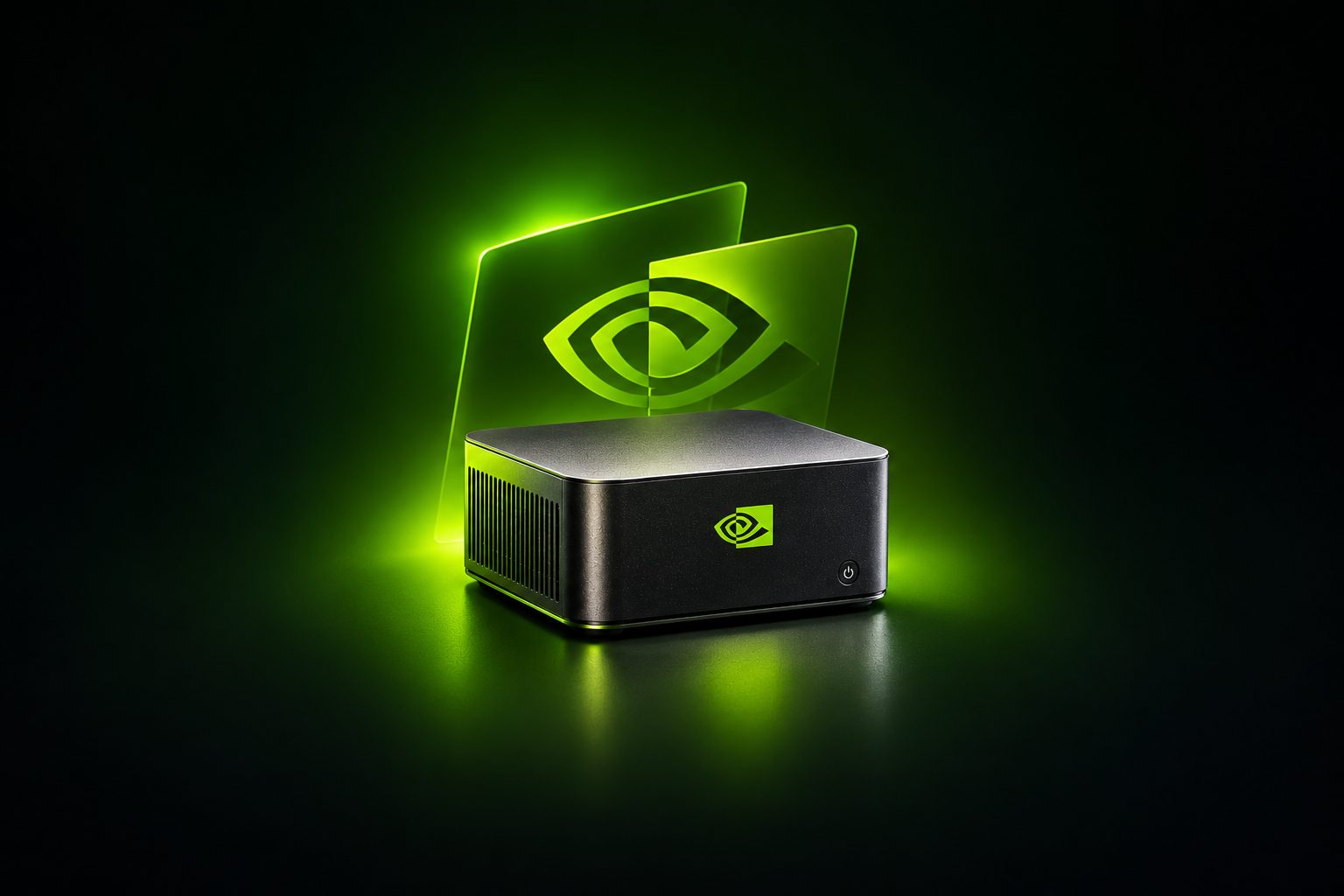
Compact Windows desktops capable of running 120-billion-parameter language models locally went on sale from ASUS, Dell and MSI, Nvidia said in a company blog post dated November 18, 2026. The RTX Spark systems pair a 20-core Grace CPU with a Blackwell RTX GPU and up to 128GB of unified memory, which Nvidia said delivers up to 1 petaflop of AI performance.
Details
- The hardware: Nvidia said each RTX Spark desktop combines a 20-core Grace CPU with a Blackwell RTX GPU carrying 6,144 CUDA cores and up to 128GB of unified memory. The company put peak AI performance at 1 petaflop, with 10-gigabit Ethernet for moving large datasets, model files and creative assets to networked storage.
- What it runs: According to Nvidia, the configuration supports running 120-billion-parameter large language models on the machine itself, rendering 3D scenes larger than 90GB in real time, and editing 4:2:2 video in real time. The company positioned the desktop as a dedicated machine that keeps agents and scheduled tasks running while a laptop is used elsewhere.
- The cost argument: Nvidia said running supported models locally keeps processed code and files on the PC and avoids per-token cloud API charges for those tasks. The company did not publish pricing for any of the systems, nor an estimate of the savings against cloud inference.
- Who is shipping: Systems from ASUS, Dell and MSI are on sale now, joining RTX Spark laptops already available, Nvidia said. Mini PCs from Acer, GIGABYTE and HP are described as coming soon, along with a Microsoft Surface RTX Spark Dev Box. No release dates were given for those models.
- The developer stack: Nvidia said native CUDA support and Linux tooling through Windows Subsystem for Linux underpin local AI workflows on the machines. Developers can build agents using Hermes Agent or Nvidia NemoClaw blueprints and fine-tune supported models with Unsloth.
- Hybrid routing: Nvidia Switchyard, now available in Hermes, automatically routes agent tasks between local and cloud models, according to the company. Routine work runs on the device while advanced reasoning draws on cloud models, which Nvidia said helps manage cloud spending across creative workflows.
- Adobe on Arm: Nvidia said it is working with Adobe to expand native Windows on Arm support and RTX acceleration across Adobe's creative applications. Illustrator and InDesign now ship in native Windows on Arm versions tuned for RTX Spark, with Illustrator running up to 30% faster than the emulated build.
- Microsoft Ignite: Also announced at Microsoft Ignite, developers can now take any GGUF model from Hugging Face and run it inside Windows ML using the llama.cpp backend, Nvidia said — widening the set of open models that can be deployed on Windows machines without vendor-specific conversion.
Between the lines
The pitch is less about raw speed than about where data sits. Nvidia's own framing — local processing, no per-token API charges, always-on agents on a dedicated box — targets buyers whose code and files cannot leave the building. Switchyard's hybrid routing concedes the limit: the heaviest reasoning still goes to the cloud.
What's next
Watch for pricing from ASUS, Dell and MSI, release dates for the Acer, GIGABYTE and HP mini PCs, and the launch of the Microsoft Surface RTX Spark Dev Box.
Source: Nvidia (company blog)