OpenAI launches GPT-6.2 Astra and Sol, cuts frontier prices 20%
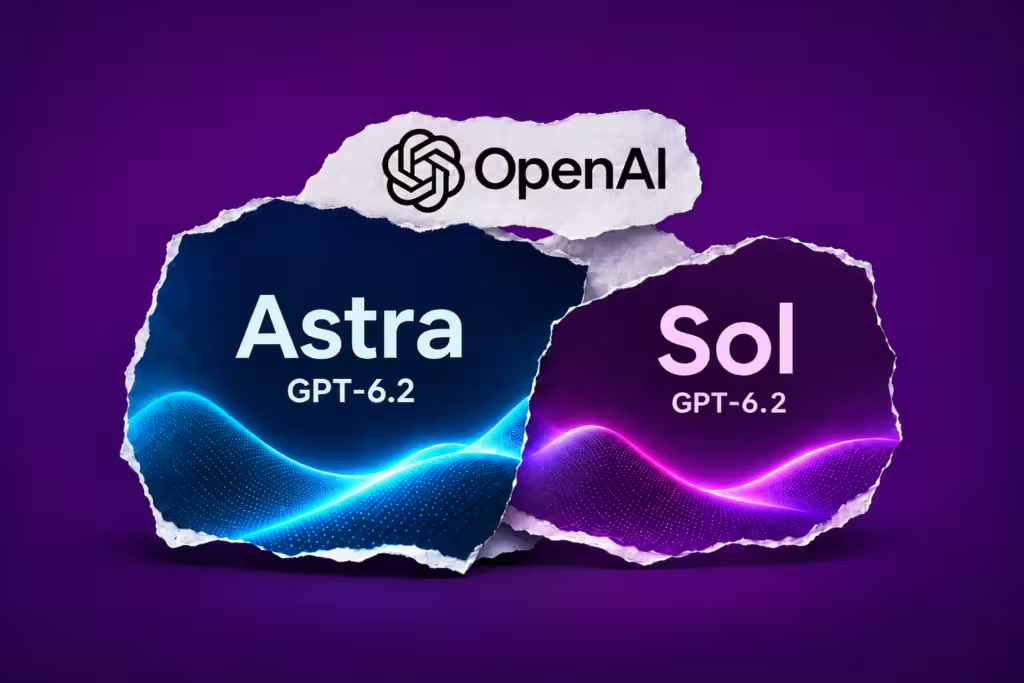
Frontier-level model access got substantially cheaper on Nov 17, when OpenAI released GPT-6.2 Astra for its hardest workloads and GPT-6.2 Sol for everyday tasks. OpenAI said both models complete demanding work using fewer output tokens, stretching usage limits further.

· Originally published by ontime+ · Last verified: 19 Nov 2026
Key Points
- OpenAI released GPT-6.2 Astra and Sol on Nov 17, with cheaper tokens.
- Astra scored 5.5 points above Claude Fable 5.2 on Agents' Last Exam.
- Lower frontier pricing pushes advanced models further into routine business and developer work.
The latest:
Frontier-level model access got substantially cheaper on Nov 17, when OpenAI released GPT-6.2 Astra for its hardest workloads and GPT-6.2 Sol for everyday tasks. OpenAI said both models complete demanding work using fewer output tokens, stretching usage limits further. Astra’s API prices come in 20% below GPT-6 Astra, with cached input discounted 60%.
Details:
- The benchmark: On Agents’ Last Exam, which OpenAI describes as a test of multistep professional work, GPT-6.2 Astra set a new high. The company said it scored 5.2 points above GPT-6 Astra at less than a third of the cost, and 5.5 points above Claude Fable 5.2 at 5% of the cost.
- Astra pricing: OpenAI listed GPT-6.2 Astra at $8 per million input tokens, $0.40 per million cached input tokens, and $40 per million output tokens. Both input and output prices are 20% lower than GPT-6 Astra, with cached input carrying a 60% discount.
- Sol pricing: GPT-6.2 Sol holds the same API rates as GPT-6.1 Sol, according to OpenAI: $2 per million input tokens, $0.10 for cached input, and $10 for output. The efficiency gain for Sol users therefore comes from fewer output tokens rather than a lower per-token rate.
- Who gets access: OpenAI said both models are available from launch day to Plus, Pro, Enterprise and Edu users inside ChatGPT Work and Codex. Developers can call gpt-6.2-astra and gpt-6.2-sol through the OpenAI API, with the Ultrafast option offered for both models at launch.
- Safety classification: Under OpenAI’s Preparedness Framework, both models meet the Critical threshold for cybersecurity and the High threshold for biological and chemical capabilities, the company said. That matches the classification OpenAI previously applied to GPT-6 Astra.
- A first for OpenAI: The company said GPT-6.2 Astra is its first externally released model to meet the High threshold for AI Self-improvement, a category OpenAI defines as measuring a model’s ability to accelerate AI research. OpenAI did not detail what additional safeguards that classification triggers.
- The efficiency claim: OpenAI said both models deliver better results on demanding tasks while producing fewer output tokens. For paying customers, that framing ties the cost argument to consumption volume as much as to the headline per-token rate.
- The pitch: OpenAI framed the release around businesses and developers, promising frontier performance at costs that it said make sense at scale. The announcement did not name launch customers or publish deployment figures.
Between the lines:
The two claims OpenAI put forward together are an efficiency claim and a capability claim: cheaper tokens and fewer of them, alongside a benchmark lead over a named rival. Attaching the first External High rating for AI Self-improvement to the same launch signals that OpenAI expects capability scrutiny to track pricing competition, not trail behind it.
What’s next
Watch for independent replication of the Agents’ Last Exam scores, competitor price responses from rival labs, and any further OpenAI disclosure on safeguards tied to the AI Self-improvement threshold.